
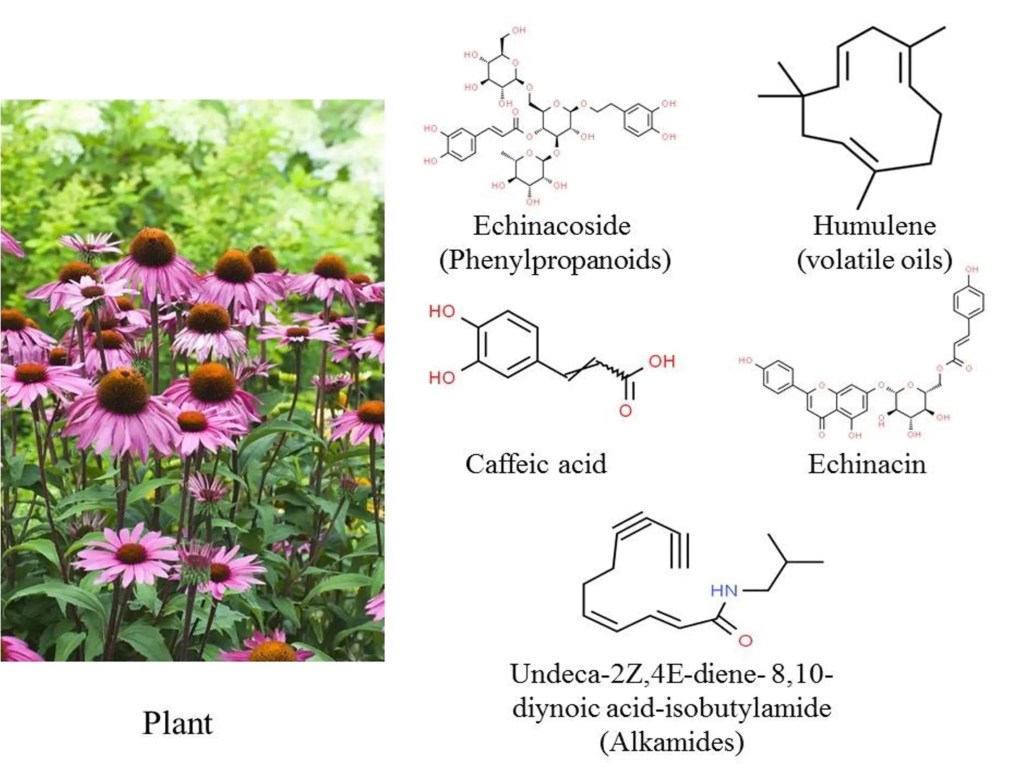
Echinacea, also known as purple coneflower, is an herbal medicine that has been used for centuries, customarily as a treatment for the common cold, coughs, bronchitis, upper respiratory infections, and some inflammatory conditions.
I will leave sources below for further investigation for those interested in learning more. I am not affiliated with any particular supplement company, but I sometimes recommend products based on medical studies, consumer reviews or personal use.
Echinacea is one of the most popular herbs in Europe and America today. People use echinacea to shorten the duration of the common cold and flu. Echinacea is also known to reduce symptoms such as sore throat (pharyngitis), cough, fever and fighting infections. You can read about one of those studies here as well as in the sources below. Also, take a look at my blogpost on colds and flu for more immune support information. Echinacea contains active substances that boost immune function, relieve pain, reduce inflammation, along with antiviral and antioxidant effects.
The key active ingredients:
Alkamides – which have antibacterial and antifungal properties
Caffeic acid esters (echinacoside and cynarin) – these have antioxidant, anti-inflammatory, and immune-stimulating properties
Polysaccharides – which help protect the body from invading microbes
Humulene volatile oil – has anti-inflammatory effects
Several clinical trials have shown that people who take echinacea as soon as they feel sick can reduce the severity of their cold and have fewer symptoms than those who do not take the herb. It is important to choose a high-quality echinacea supplement and to use echinacea as early as possible in the course of a cold, with multiple doses per day for the first few days.
A study performed by ConsumerLab.com (an independent company that tests the purity of health, wellness, and nutrition products) found that of 11 brands of echinacea purchased for testing, only 4 contained what was stated on their labels. About 10% had no echinacea at all; half were mislabeled as to the species of echinacea in the product; and more than half of the standardized preparations did not contain the labeled amount of active ingredients.
Buy products made by reputable, established companies. When possible, select products with guaranteed potency or standardized extracts. Some of the companies with superior sourcing, rigorous testing and high quality supplements are: Natures Sunshine, Gaia Herbs, Herb Pharm, NOW foods, Naturesway, Mountain Rose Herbs.
You can also grow your own to harvest and dry from your own yard to make teas or tinctures. [1][2] Echinacea purpurea or echinacea augustifolia are perenniels (will come back every year) native to North America and are the 2 main species grown for medicinal uses. They make a beautiful addition to gardens and landscapes. If you’d like to skip the seed starting process, established seedlings can be purchased at plant nurseries. Check the botanical name on the plant label for “purpurea” or “augustifolia”. If you are in the NJ area, you can purchase young plants at Well Sweep Herb Farm. Excellent source if you are just starting out growing an apothecary garden or for beautiful landscape plants. Very well educated staff as well.
In Germany (where herbs are regulated by the government), the above-ground parts of Echinacea are approved to treat colds, upper respiratory tract infections, urinary tract infections, and slow-healing wounds. The root of the Echinacea plant is also approved for the treatment of flu-like infections. The plant has no known toxicity and is beneficial for adults, children and yes, pets.
How to take:
“Early, Often and After!” Per Dr. Patrick Jones, ND, DVM, Clinical Herbalist, engaging herbal remedies at the earliest signs of illness will have a profoundly superior effect compared to starting them after you’ve been sick for a week. This is particularly true of infectious disease cases or anything involving inflammation.
Once or twice a day isn’t enough in cases of acute illness. Your immune system needs regular support to function at its best. Taking a dose of herbs every three or four hours will be much more effective.
Taking herbs after you feel better for a few days gives the body the continued support it needs to return to health and helps to prevent a relapse. Once a person is on the mend, back the frequency down to two or three times daily and continue for a few days.
Echinacea can be purchased as powder or tea, capsules and liquid tinctures. Seven to ten days is usually sufficient, but can be taken up to 6 weeks. After that, it has shown to stress the liver and suppress immunity.
Herbs and Adults
Powders for Adults: 1-2 rounded teaspoons 2-3 times daily.
Tinctures for Adults: 1/4 to 1 teaspoon 2-3 times daily.
Capsules for Adults: 4 capsules 2-3 times daily.
Herbs and Children
Don’t use herbs in children without consulting a physician. Taking echinacea by mouth seems to be safe in most children ages 2-11 years, but rashes due to an allergic reaction can occur. See additional considerations below. Try to use glycerin extracts with children to avoid the alcohol in most tinctures. Kids can take straight off a spoon or mixed in juice or smoothies. According to Dr. Patrick Jones, when using herbs for children, dose them based on weight compared to an adult (approx 150 lbs) …1/2 an adult…1/3 of an adult etc…Echinacea has been shown to be beneficial and safe for kids, however for other herbs, research and make sure the herbal plant is safe for little ones.
Herbs and Pets
Most dogs will eat herbs willingly if the powdered form is mixed with a little wet food. Tinctures can also be used. Cats are often very resistant to taking herbs willingly. For chronic or maintenance issues, twice daily is usually sufficient. For acute situations, dosing can be done more frequently.
Powders for Pets
Under 10 Pounds: 1/8 teaspoon twice daily
10-20 Pounds: 1/4 teaspoon twice daily
20-40 Pounds: 1/2 teaspoon twice daily
40-60 Pounds: 3/4 teaspoon twice daily
Over 60 Pounds: 1 rounded teaspoon twice daily
Tinctures for Pets:
Under 10 Pounds: 3 drops twice daily
10-20 Pounds: 5 drops twice daily
20-40 Pounds: 10 drops twice daily
40-60 Pounds: 20 drops twice daily
Over 60 Pounds: 30 drops twice daily
Capsules for Pets:
Under 10 Pounds: 1/4 capsule twice daily
10-20 Pounds: 1/2-4 capsule twice daily
20-40 Pounds: 1 capsule twice daily
40-60 Pounds: 2 capsules twice daily
Over 60 Pounds: 3 capsules twice daily
Additional Considerations
Duration of Use: Echinacea is typically recommended for short-term use (7–10 days) to boost immunity during colds or flu.
Allergic Reactions: Some individuals, particularly those allergic to plants in the daisy family (e.g., ragweed, marigolds), may have allergic reactions to echinacea.
Interactions: Echinacea may interact with certain medications or conditions (e.g., autoimmune diseases).
Always consult a healthcare provider before starting any herbal supplement, especially for children or individuals with specific health concerns.
Sources
https://pmc.ncbi.nlm.nih.gov/articles/PMC9102300/#sec3-plants-11-01244
draxe.com/nutrition/echinacea-benefits
https://pmc.ncbi.nlm.nih.gov/articles/PMC8320399/
https://pmc.ncbi.nlm.nih.gov/articles/PMC2265595/
https://pmc.ncbi.nlm.nih.gov/articles/PMC8028575/
PDR for Herbal Medicines, 4th edition, echinacea, Robert Cullen, Chief Medical Officer, Thomson Healthcare Inc. 2007
Barrett B, Vohmann M & Calabrese C, Echinacea for upper respiratory infection. Journal of Family Practice, 4(6):628-635. 1999
The ABC Herbal, Horne, Steven. Wendell W. Whitman Company, 1992


 Naturally Renewed
Leave a comment